Holiday Light Stakes and Inflatables on Artificial Turf in Tucson: Pins, Cords, and the Week Before Thanksgiving
Why a pencil-wide hole beside a Tucson inflatable is a torn backing, and how to set holiday lights and chairs on artificial turf before Thanksgiving.
Key Takeaways & Quick Summary
- National Weather Service 1991–2020 normals for Tucson put November's average high at 75.1°F, the average low at 47.9°F, and rainfall at 0.56 inches. December's normal rainfall on that table is 0.96 inches, with an average high of 65.5°F and an average low of 40.5°F.
- NFPA's holiday decorating article says to inspect lights, motors, wires, and extension cords before use. Broken lamp sockets, broken motor housings, and cracked cord covers can expose conductors. Exterior receptacles need GFCI protection, and the article says to test it before use.
- The same NFPA article cites section 590.5(B) of the 2026 National Electrical Code, which permits temporary holiday decorative lighting and its wiring for not more than 90 days. String lights left up longer may be treated as lampholders and may need an inspection.
- A SportsTurf summary of the Synthetic Turf Council's infilled-turf guidelines says no system is maintenance free, that ferrous metal should be removed from the surface, and that metal spikes should be prohibited. A stake hole that has dropped the sand is an installer repair. A flat chair lane with the backing intact is a cleaning.
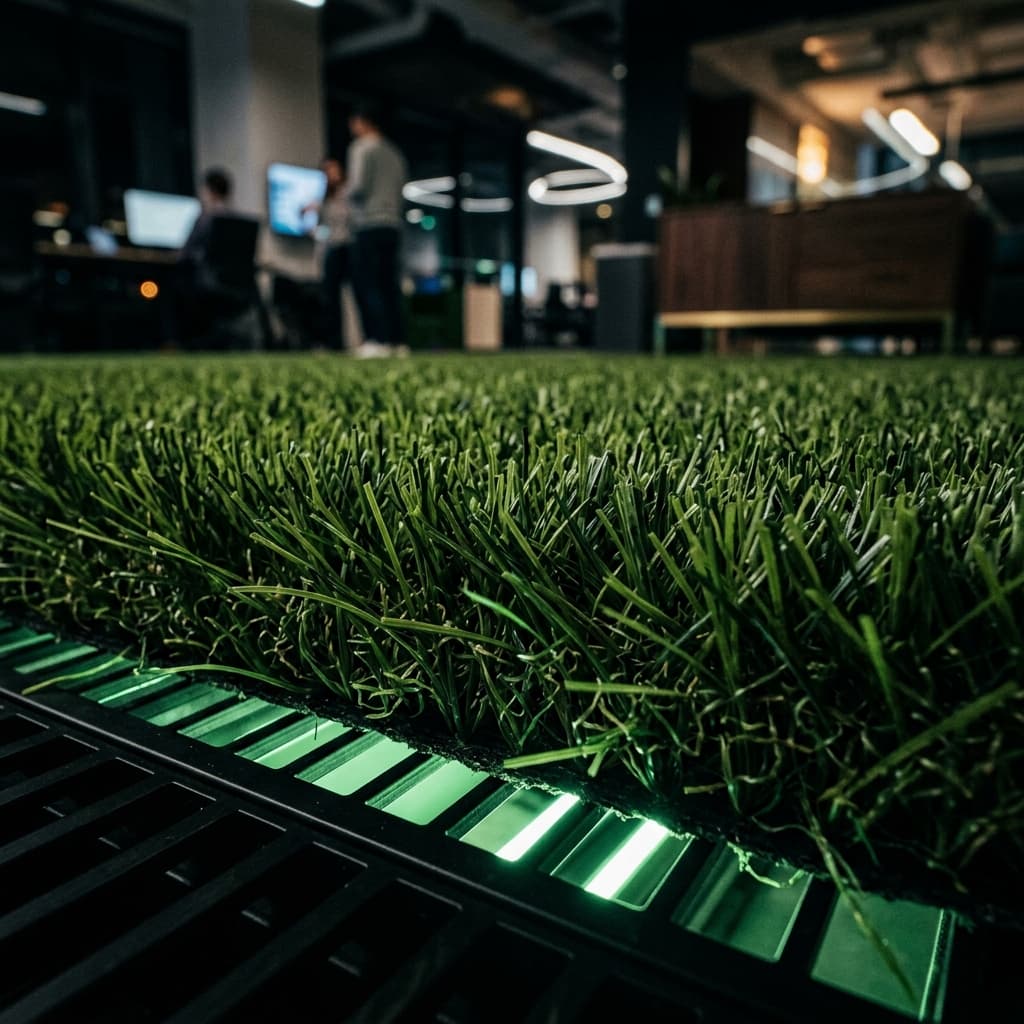
A round hole in the backing is not one of the weep holes. Those holes are small, and they repeat on a pattern. This one is about the width of a pencil, the sand around it has dropped, and a plastic stake is still in it. The week before Thanksgiving is when that hole shows up on artificial turf in Green Valley.
The box of lights comes down on the first mild Saturday. Courtyard lawns in Oro Valley get the inflatable. Front strips in SaddleBrooke get a row of candy-cane stakes. Patio yards in the Catalina Foothills run a cord across the grass to reach the outlet. The decoration is what you see from the street. The pin is what the backing keeps.
1. November Is When the Box Comes Out
The National Weather Service 1991–2020 normals for Tucson put November's average high at 75.1°F, the average low at 47.9°F, and the rainfall at 0.56 inches. Afternoons are warm enough to stand outside and sort the bin. Nights are cool enough that an inflatable on the lawn looks like the plan. Half an inch of rain for the whole month will not lift sand back up through a tear.
December on that same table is a 65.5°F average high, a 40.5°F average low, and 0.96 inches of rain. A pin left in the lawn sits in whatever rain December actually delivers, and a cord in the same sand stays damp. Our fall and winter turf care guide covers the rest of the cool season, including dust, seed, and pet waste that stays quiet until the yard heats up. Stakes are the holes that were not there in October.
2. A Stake Opens the Backing
Water leaves through the weep holes into the aggregate under the lawn. A light stake, a shepherd's hook, a tent spike, or the anchor in an inflatable kit makes a separate opening. It can split the fabric between the holes and cut the yarn at the tuft lock. Sand drops through, and the blades around that spot flop.
Part the fibers before you decide what you are looking at.
- A small hole with the sand still level with the rest of the lawn is a weep hole. Leave it.
- A larger hole with a collar of missing sand, or a slit with a pin still in it, is a puncture. Pull the pin straight up. Do not rock it.
- Glossy, fused tips with no hole under them are melt from a lamp or a heater. That scar is not a stake, and brushing it will snap the fiber.
The SportsTurf article Maintenance and performance guidelines for synthetic turf fields (July 2013) summarizes the Synthetic Turf Council's suggested guidelines for infilled synthetic turf. It is written for sports fields. It says no synthetic turf system is maintenance free, that ferrous metal objects should be removed with a magnet on the grooming equipment, and that metal spikes on footwear should be prohibited. Flat-soled shoes, it says, intensify wear. A separate note lists fires, fireworks, and storage of heavy materials among the things that may damage the surface. A backyard stake is metal left in the pile on purpose. Pull it the day the display comes down.
3. Inflatables, Cords, and a Tested Outlet
The National Fire Protection Association article Practice Electrical Safety When Decorating for the Holidays starts with inflatable reindeer, snowmen, and lights on the house and the trees. Inspect the lights, the motors, the wires, and the extension cords before you use them. Broken lamp sockets, broken motor housings, and cracked cord covers can leave the conductors exposed.
The article says GFCI protection on exterior receptacles is essential, and that you should test it before use. Outdoor receptacles need that protection through a breaker or the receptacle. If the patio outlet is not a GFCI, a qualified person should install one. Plug the display in after the test.
NFPA cites section 590.5(B) of the 2026 National Electrical Code, which permits temporary holiday decorative lighting and its wiring for not more than 90 days. The article separates that from string lights left up longer, such as lights around a deck, which may be treated as lampholders and may need an inspection. A seasonal inflatable and a stake-in light set are the temporary display. Take them down inside the 90 days, and pull the pins the same afternoon.
Lay the cord on the concrete or the gravel. Do not tuck it under the infill or cut a slit at the edge to hide it. A buried cord is where a dog chews, and it holds moisture against the backing. If the kit wants a stake, use the sandbag or the water weight instead. A bag presses the blades flat and comes off with the display. A spike cuts the backing.
4. Chairs, the Cooler, and the Path to the Table
Thanksgiving week puts folding chairs on the same lawn. Each foot presses a divot and kicks sand sideways. Drag the chair and the divot becomes a lane, with the blades laid over so you see the side of each ribbon.
The SportsTurf summary says infill levels become uneven in high-wear areas, so the fibers lose support. On a courtyard, that area is the path from the slider to the table. Lift the chairs and the table. Put the cooler on the patio. A cooler left on the grass sweats a ring, and the next dust sticks there.
Keep the truck on the driveway. Those guidelines say not to park a vehicle on the surface, and not to let a hot muffler touch it.
5. Set the Display Before You Plug It In
Do this while the stakes are still in the box.
- Put inflatables and the reel of lights on the patio, the pavers, or the gravel. A line that has to cross the lawn gets a freestanding base, not a stake.
- Look at every cord. A cracked socket or a split cover stays in the trash. Plug the set into a GFCI receptacle, and test it first.
- Keep the cord out of the infill.
- Pull every pin the day the lights come down. After guests leave, part the blades on the chair line. Loose sand can be brushed back. Backing showing through is past a broom.
6. When the Hole or the Flat Lane Is Already There
If a stake has already split the backing, stop brushing that spot. A broom works more sand into the tear. That opening is a repair for the installer who seamed the lawn. Say "stake hole" when you request a quote. Cleaning does not sew a backing.
If the blades are only flat and the backing is whole, the sand is still there. It is displaced, and feet have packed it. Artificial turf cleaning power-brooms that lane and extracts the dust the chairs worked in. On courtyards that host the same weekend every year, artificial turf cleaning in Oro Valley is often this path plus the dust already in the sand. In SaddleBrooke, turf maintenance before the box comes out of the garage is the visit that finds a low spot in the infill.
A single flat strip, with the rest of the lawn still upright, fits the service packages. The Turf Tune-Up starts at $150 and Refresh+ at $195, each up to 300 square feet. A yard that holds people every cool weekend stays ahead of the next chairs on a maintenance plan. The plan is for the sand and the blades. It does not patch a stake hole.
What Not to Do
- Do not stake lights, inflatables, tents, or shepherd's hooks through the turf.
- Do not bury an extension cord in the infill, and do not slit the edge to hide one.
- Do not plug in a cracked socket or a split cord. Test the GFCI first.
- Do not drag chairs or a table, and do not park a vehicle on the lawn to unload.
- Do not hose the yard to freshen it before guests. Water drives dust into the weep holes.
- Do not leave the pins for spring. December's normal rainfall is 0.96 inches, and that rain sits in any hole still open.
If the lawn in Green Valley, Oro Valley, SaddleBrooke, or anywhere else in the Tucson metro already has a pin in it, or a lane flat under the table, say which one you are seeing when you call 520-248-3478.
Frequently Asked Questions
Can I stake Christmas lights into artificial turf?
No. The weep holes are already in the backing. A light stake, shepherd's hook, tent spike, or inflatable anchor makes a new tear, and the sand falls through it. Use a freestanding base, or set the display on the patio or the gravel.
Can an inflatable decoration sit on artificial grass?
The figure can sit on the blades if nothing punches through them. NFPA's holiday article is about the motor, the cord, and GFCI protection. Use the sandbag or water weight instead of the stake, and take the bag off when the display comes down. Inspect the cord for a cracked cover before you plug it into a tested GFCI receptacle.
Will Thanksgiving chairs ruin artificial turf?
Chair feet press the infill aside and lay the blades down. Lift the chairs and the table instead of dragging them. The SportsTurf summary of the Synthetic Turf Council guidelines says infill levels become uneven in high-wear areas and that flat-soled shoes intensify wear. A flat lane with the backing still whole can be power-broomed. A torn spot cannot.
How long can outdoor holiday lights stay up?
NFPA cites section 590.5(B) of the 2026 National Electrical Code, which permits temporary holiday decorative lighting and the wiring with it for not more than 90 days. Take that seasonal set down inside the window, and pull the stakes the same day. The article treats longer-term string lights, such as deck lights, as a separate case that may need an inspection.
Veteran-owned and operated synthetic grass restoration specialists serving Tucson, Oro Valley, Marana, Catalina Foothills, Sahuarita, and all of Pima County, AZ. Backed by our 7-Day 100% Odor Elimination Guarantee.